Can AI grow your sales? 30 days of an AI assistant in a Swiss online shop
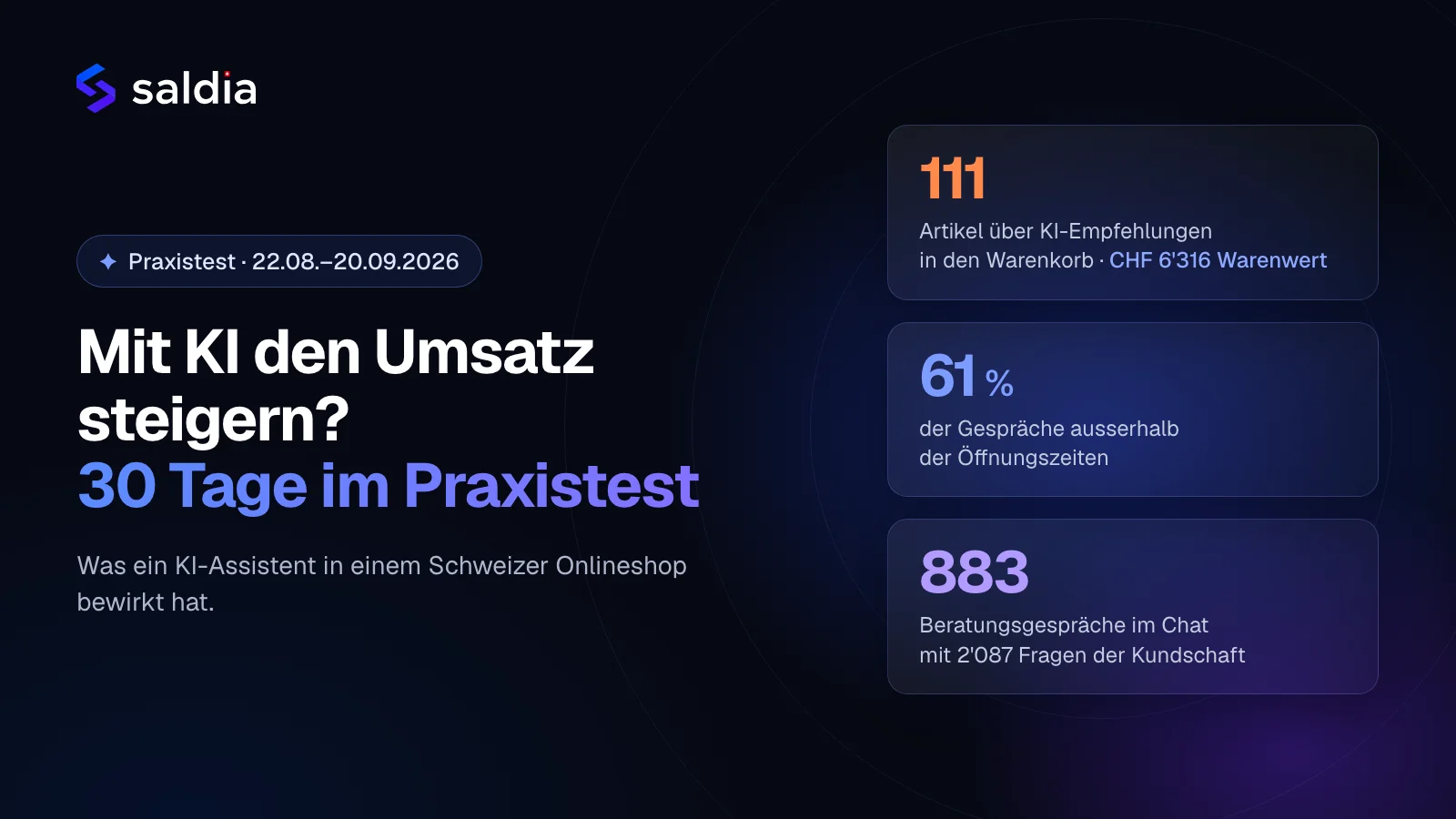
111 items worth CHF 6,316 in the basket, 61 % of chats outside opening hours: what the AI assistant in saldiaSearch achieved in 30 days in a Swiss shop.
 Lorenz Schmid Updated on 9 min read
“Grow your sales with AI” – almost every piece of software for online shops promises that right now. It is rarely backed up. We wanted to know for sure and counted: 30 days, one Swiss online shop, one AI assistant. Here is what came out of it. And also what we cannot measure yet.
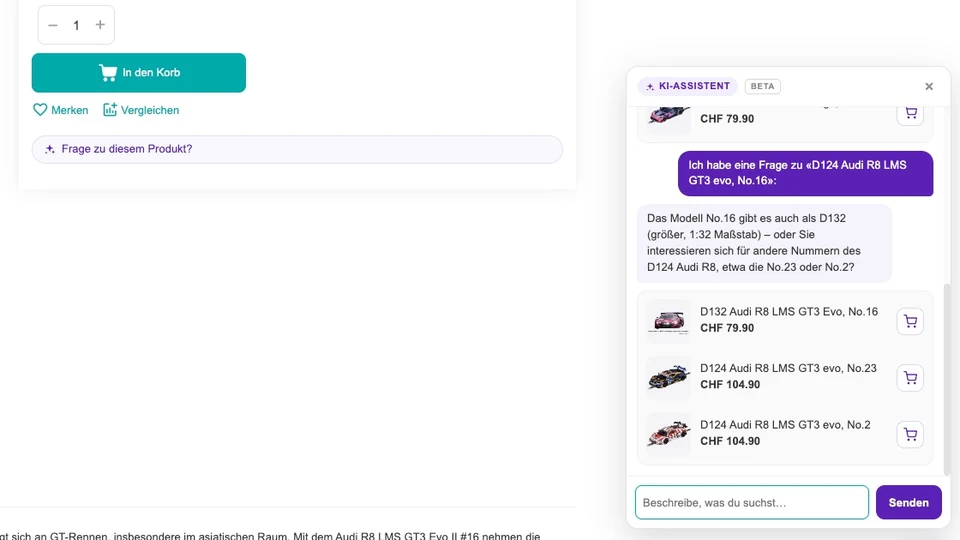
Since mid-August, the AI shopping assistant in saldiaSearch has been advising the customers of a Swiss specialist retailer for model building and RC models. The retailer runs its own physical shop and sells online in German and French. There, the assistant advises in the chat, steps in during search, suggests matching accessories in the basket and shows available alternatives on sold-out product pages. How it works is covered in the post on the launch of the AI assistant. This one is about the impact, measured from 22 August to 20 September 2026.
The numbers at a glance
| 30 days, one shop | Value |
|---|---|
| Items added to the basket via AI recommendations | 111 |
| Merchandise value of these items | CHF 6,316 |
| Advice conversations in the chat | 883, with 2,087 questions typed by customers |
| Conversations outside opening hours | 61 % |
| Clicks on recommended products | 1,147 |
One of these numbers needs context straight away, because it looks the most like revenue: the CHF 6,316 is not revenue. It is the price shown on the product card when someone clicked “Add to basket”. Whether the basket was paid for afterwards is something we do not measure yet. We are working on matching completed orders and will publish the revenue figure once it is reliable.
Advice when the shop is closed
The number that surprised us most has nothing to do with the basket: 61 % of conversations took place while the physical shop was closed. Before opening, over lunch, in the evening, at night and on Sunday. The busiest times are the weekend and the evening between 9 and 10 pm.
That is exactly when nobody is standing in the shop, nobody picks up the phone and an email gets answered the next morning at the earliest. Anyone who wanted to know at half past nine in the evening whether a body shell fits their chassis used to get no answer. Whether they would have asked again the next day or moved on, we do not know. Now they get an answer, with matching products from the range.
And customers use it: 883 conversations with 2,087 questions they typed themselves. That is more than two questions per conversation on average. People follow up, narrow things down and compare, just like in a shop.
Three real questions
Three conversations from the measurement period, shortened:
Question: Does the body shell fit my TT-02 chassis? I have the Tamiya Porsche 911 GT3 R kit.
Answer: According to the catalogue, this body shell is built for a different chassis; the TT-02 needs a TT-02 body shell.
The question is settled before something that does not fit gets ordered. The assistant then shows two Porsche models for the TT-02, and one of them is clicked.
Question: Is there a cheaper version of the Spektrum charger?
Answer: Shows two cheaper Spektrum chargers and asks whether a single or a dual charger is wanted.
A dual charger is wanted. Two answers later, the assistant shows a matching dual charger, and it goes into the basket for CHF 199.90. A question about price turned into an item in the basket because someone asked back.
Question: Does the rear skid plate fit an Arrma Typhon TLR Tuned?
Answer: Cannot confirm the fit for this model and instead shows a skid plate made for the ARRMA 6S models.
The third example matters most to us. The assistant does not simply say “yes” to make a sale. What it cannot back up from the catalogue, it does not confirm; instead it shows what demonstrably fits. The suggestion is clicked.
Behind this is a rule we built on purpose: the assistant only recommends products from the shop’s catalogue that are available. Prices and availability are on the product cards, not in the text of the answer.
Where the recommendations work
The assistant meets customers in five places in the shop, and they contribute very differently:
| Where | Clicks | Added to basket | Merchandise value |
|---|---|---|---|
| In the basket (matching accessories) | 371 | 89 | CHF 3,468 |
| On sold-out product pages (available alternatives) | 356 | 12 | CHF 2,371 |
| In the chat (product cards in the answers) | 201 | 10 | CHF 477 |
| In search (on zero results and in the empty search window) | 219 | – | – |
| Total | 1,147 | 111 | CHF 6,316 |
The fifth place is the line “A question about this product?” on every product page. Through it, the chat was opened 470 times, with the product already in context.
In the basket: the most items
89 items worth CHF 3,468 were added through the suggestions in the basket. The click rate is 3.4 %: that share of the suggestions shown was clicked. And it is not just small items to round up the order. They included complete models, such as a Tamiya buggy and a Traxxas monster truck, both over CHF 400.
On sold-out pages: the highest value per item
A sold-out product page is a dead end: whoever lands there wanted to buy something and finds no buy button. That is exactly where the assistant shows alternatives that are available. 356 of them were clicked, and 12 items went into the basket, worth CHF 2,371 together. That is almost CHF 200 per item, more than anywhere else.
The most expensive item of the whole month got into the basket exactly this way: an all-metal 1:18 excavator for just under CHF 1,000, suggested on the page of a sold-out product.
In the chat: advice first
The chat puts the fewest items directly into the basket: 10 items worth CHF 477. We say that openly because it fits its role. The chat is where things get clarified, compared and followed up, and not every conversation ends with a click on “Add to basket”. The charger from the second example shows what it looks like when it does.
In search: suggestions instead of an empty page
When the search finds nothing, the AI suggests matching products. In the still-empty search window, it shows suggestions based on the products viewed last. Together, that came to 219 clicks.
94 % of requests came from bots
One number from the measurement period belongs in every discussion about AI in online shops: in the last ten days, 94 % of all requests for AI recommendations came from automated programs – 241,661 out of 257,907. They include the AI crawlers of large platforms that fetch pages systematically.
The assistant recognises them and does not answer them. So they use up no AI answers and are not part of any number in this post. Anyone running an AI assistant without such detection risks paying for every one of these requests – and reads figures in their statistics that mostly come from machines.
So: does AI grow sales?
The honest answer after 30 days has three parts:
- What is proven: the recommendations put items into the basket – 111 of them worth CHF 6,316 in a single shop. And that in a month in which the recommendations in the basket, on sold-out pages and in search largely failed for about four days because of a technical fault on our side. So the numbers are, if anything, too low.
- Also proven: customers use the assistant above all when nobody else can answer. In an online shop, advice is no longer tied to opening hours.
- Still open: how much of it was paid for in the end. We will deliver that number as soon as we can match completed orders cleanly.
What you can take away for your shop
Some lessons from these 30 days apply whatever tool you use:
- Advise where the question comes up. In the basket, on the sold-out page, on the product page. Not in a window that opens by itself: we measured back in August that popups like that perform poorly, and scrapped our own because of it.
- Sold out is not the end of the road. Anyone who lands on a sold-out page wants to buy. An available alternative in exactly that spot was, in our measurement, the most valuable recommendation per item.
- Your opening hours are the gap. Check when your customers shop. If it is in the evening and at the weekend, that is exactly when they have questions and nobody answers.
- Count clicks, not impressions. With a 94 % bot share, an impression count says little. What matters is what people click and put in the basket.
How to read the numbers
- Period: 22 August to 20 September 2026, one shop with a German-language and a French-language storefront. One shop and one month: the numbers show what happened at this retailer and are no promise for other product ranges.
- Merchandise value: the price on the product card at the click on “Add to basket”. Not revenue.
- Conversation: a visitor’s chat history on one day, with at least one question they typed themselves. Automatic AI answers to searches without results do not count as conversations. Counted without cookies; a visitor is only recognised again on the same day.
- Clicks: each recommended product counts once per visitor and day. The click rate is the share of displayed products that were clicked.
- Opening hours: the actual opening hours of the physical shop, in Swiss time. All other times count as “closed”.
- Fault: from 11 September (early) to 15 September (morning), the recommendations in the basket, on sold-out pages and in search largely failed. These days are included.
- Bots: the numbers are based on clicks, conversations and baskets of real visitors. The 94 % bot share refers to the last ten days of the period.
The AI assistant for your shop
The AI assistant is part of saldiaSearch and switched on in every saldiaShop with saldiaSearch; you pay for it per use, with no subscription. You can see at any time in the backend, under “AI recommendations”, what the assistant achieves in your shop: clicks, basket additions and merchandise value per placement, for 7, 30 or 60 days.
If you would like to try it, get in touch. We will enable it for your shop.