A Board That Doesn't Yell at You: the Focus Module for Neurodivergent Minds – and Everyone Else
Three cards, never yelled at in red, a 5-minute tunnel: why our focus board is deliberately low-stimulus – for neurodivergent minds and everyone else.
 Men Wälti 8 min read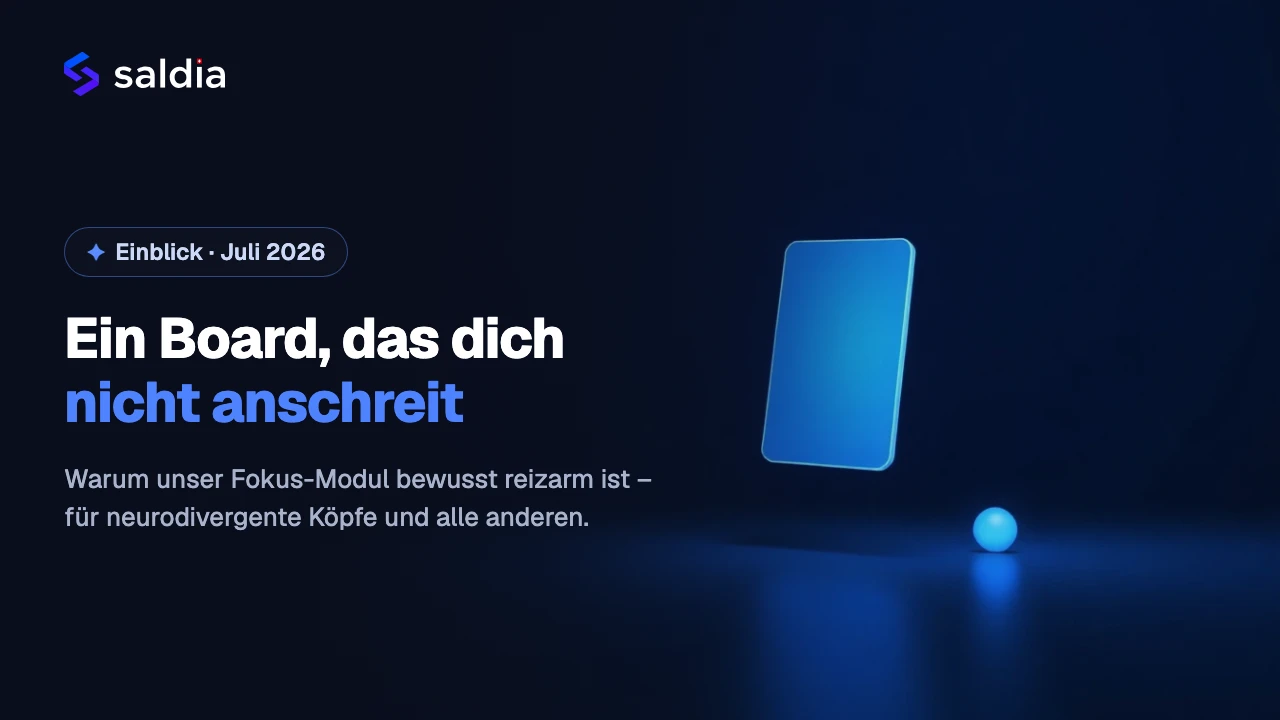
Why the Focus module looks the way it does
This week we launched the new Focus module in saldiaCore – everything that's in it is in the launch post. This article tells the other half of the story: why the board looks the way it does. Why Today only takes three cards. Why nothing flashes red. And why we deliberately built it with neurodivergent minds in mind – for example with ADHD.
To be clear right away: the Focus module is a work tool, not a medical aid. It organizes tasks and ideas – nothing more, but also nothing less. And as it turns out, it's not only neurodivergent people who benefit, but pretty much every busy head in a loud work week.
The problem with well-behaved to-do lists
Most task tools silently assume that a mind works linearly: capture, prioritize, work through, tick off. Many minds don't – and classic to-do lists punish exactly them:
- The endless list: Twelve entries, all visible, all at once. The head starts scanning, weighing, postponing – instead of starting.
- The priority theater: "High, medium, low" always ends the same way – everything is "high", and priority means nothing anymore.
- The red yelling: Overdue tasks glow red, pile up and become a mountain of guilt. At some point you stop opening the tool at all – not out of laziness, but because it feels bad.
- The capture hurdle: Pick a project, a category, a due date, a priority – by the time the form is filled in, the thought is gone.
For neurodivergent people these aren't cosmetic flaws but real blockers. Exactly the transitions these tools presuppose – from thought to captured task, from chaos to order, from intending to starting – are where the most energy is spent. A tool that adds friction at every one of these transitions works against the mind instead of with it.
Six rules we gave ourselves while building
So we built the Focus module the other way around: fewer options, hard limits, lots of automation. A few of the guiding principles are literally written in our code – we quote them here unchanged.
- 1. Hard limits instead of self-discipline. Today takes a maximum of three cards – and this limit deliberately cannot be raised. It's not a daily quota but a simultaneous limit: finish a card and the next one moves up. Twenty things done in a day is no problem – just never more than three competing for your attention at once.
- 2. Priority is position. There is no priority field. What matters is what's on top – you drag the cards into the order you want to tackle them. Due items sort themselves upward.
- 3. Never yell in red. Due items are quietly sorted to the top and subtly marked. At midnight, anything unfinished moves back to "Later" without comment – no overdue stamp, the day starts fresh. Old ideas gently decay onto the pinboard, and once a week a check asks honestly: keep, move or let go? Our code literally says: "no nagging character".
- 4. Capturing must cost nothing. ⌘J from anywhere, type or speak your thought, hit Enter – done. No required fields, no categories. Thanks to an audio-native AI model, voice capture even understands Swiss German. Sorting comes later – because every required field at capture time kills the impulse to write things down at all.
- 5. Starting is the hurdle, not keeping going. That's written verbatim in our code – and that's why the Tunnel exists: a single card, a deliberately small 5-minute timer, no navigation. Once you've started, you usually keep going. In between sits Zen mode, which hides everything that isn't the board.
- 6. Nothing may stay invisible. Another original quote from the code: tasks, tickets, projects and deals that are assigned to you and dated appear automatically as cards on your board. You don't have to remember to transfer them – that would be another one of those expensive transitions.
Built for neurodivergent minds – helpful for everyone
Maybe you know the principle of curb cuts: built for wheelchairs – and then suddenly they were better for everyone, from strollers to rolling suitcases. That's exactly how we see the Focus module. The hard limits, the quiet due dates, the one-second capture are aids we built with neurodivergent people in mind – and they make work easier for everyone who wears many hats at once: owner, supporter, salesperson, bookkeeper, often all in one person.
One thing matters to us here: you don't need a label or a diagnosis to use the board – and it doesn't replace medical or therapeutic support. It's simply a work environment that costs less energy.
When the AI takes over the sorting
The most expensive step often isn't the work itself, but the ordering before it. That's exactly where the new AI helpers in the Focus module come in:
- Brain-dump splitter: Write everything out in one go – the AI turns it into clean, separate cards.
- What today? One click and the AI picks the most sensible tasks for today from "Later" – the empty Today column fills up without you having to prioritize.
- Break into steps: A big, vague card ("relaunch the website") becomes concrete, tickable sub-steps.
- Auto-cluster: A board that's filled up groups itself by topic with one click.
- Weekly review coach: During the weekly cleanup, the AI recommends per card: keep, move or close.
Put differently: the mind delivers the thoughts, the board takes over the admin – not the other way around.
Talk to your board
Freshly added: speaking no longer just creates cards – Focus AI understands what you want and does it. "The quote card to today." "Dentist card is done." "Move the website card to next Tuesday." One mode for everything: a thought becomes a card, a stream becomes several, a command gets executed – and if a real task or ticket sits behind a card, ticking it off completes the source too. Swiss German included.
Right here, the trust design mattered more to us than the wow effect – it follows the same rules as the whole board:
- After every recording, the board shows exactly what happened – one tap on undo rolls everything back.
- If the AI isn't sure about something, it becomes a note – never a wrong action.
- Deleting by voice deliberately doesn't exist.
- A dedicated recording screen – fullscreen on your phone – shows the live mic level, example commands to learn from, and big done and cancel buttons.
Commands apply to the cards of your own board; on shared pinboards, voice deliberately only captures ideas. No voice assistant rummaging through the whole system – your board, your rules.
The board explains itself
And one more thing built very deliberately this way: instead of a manual to read, there's an interactive tour. It dims the page and shows you the real elements one after another – one sentence per step, tap means next, cancel anytime. It starts by itself on your first visit, and after that you bring it back via the lightbulb as often as you like. Nobody reads manuals – so the board doesn't demand one.
Your board and your CRM are now one
The second wave from the same day carries the same rules one level deeper into the system:
- The remote control for your CRM: Mirror cards now act back — you edit a TODO's text and due date right from the board, and a thought attaches itself via search to a ticket, task or deal, where it becomes a real team TODO. You never have to switch views just to maintain a TODO — one more expensive transition gone.
- The declutterer makes your plan honest again: Fifteen things "due today" aren't a plan, they're a guilty conscience. Focus AI suggests per entry: the most important stays today, the rest spreads realistically across the week, vague evergreen tasks lose their pseudo-date. Every line adjustable, one click applies — and without AI, a solid distribution fallback kicks in.
- "Later" sorts itself: From about ten cards, the column groups itself by due date, collapsible. And when you set a date, a quiet hint tells you if a day is already overloaded — before the guilt mountain forms, not after.
- Recurring cards that never yell: "Weekly report every Friday" automatically creates the next instance when you complete one — never retroactively overdue.
- Capturing stays frictionless: Via the share menu, anything you spot on the go lands right on the pinboard — a link becomes a chip, text becomes a note, an image or PDF attaches (via the installed app). And the central button of the mobile bar can be assigned to Focus AI: one tap, speak, done.
- Gentle rituals instead of alarms: On your first board visit of the day with an empty Today, the board offers "What today?" by itself — once a day, no pressure. And your day sits as a "Focus — Today" widget on the CRM dashboard, with one-click tick-off.
And in a team?
Your personal board always stays private – that matters to us. Alongside it there are shared pinboards as common idea spaces: with live presence, voting, emoji reactions, connection lines, a workshop timer and an AI summary at the end of the session. An idea that concerns you goes to you via "to my board" – and from then on your rules apply again: three cards, no red stamps, your pace.
Try it out
The Focus module is part of saldiaCore, our all-in-one business software for Swiss SMEs – together with CRM, support, projects, time tracking and HR. You'll find all modules on the saldiaCore product page, and the whole update in the launch post.
And if you want to know whether your workday feels better with three cards than with twelve: request a demo – we'll show you the board live, from Burgdorf.