When is an all-in-one business software worth it for an SME?
When is an all-in-one business software with CRM, support and projects worth it for a Swiss SME? An honest guide – saldiaCore complements bexio.
 Stefan Sempach Updated on 7 min read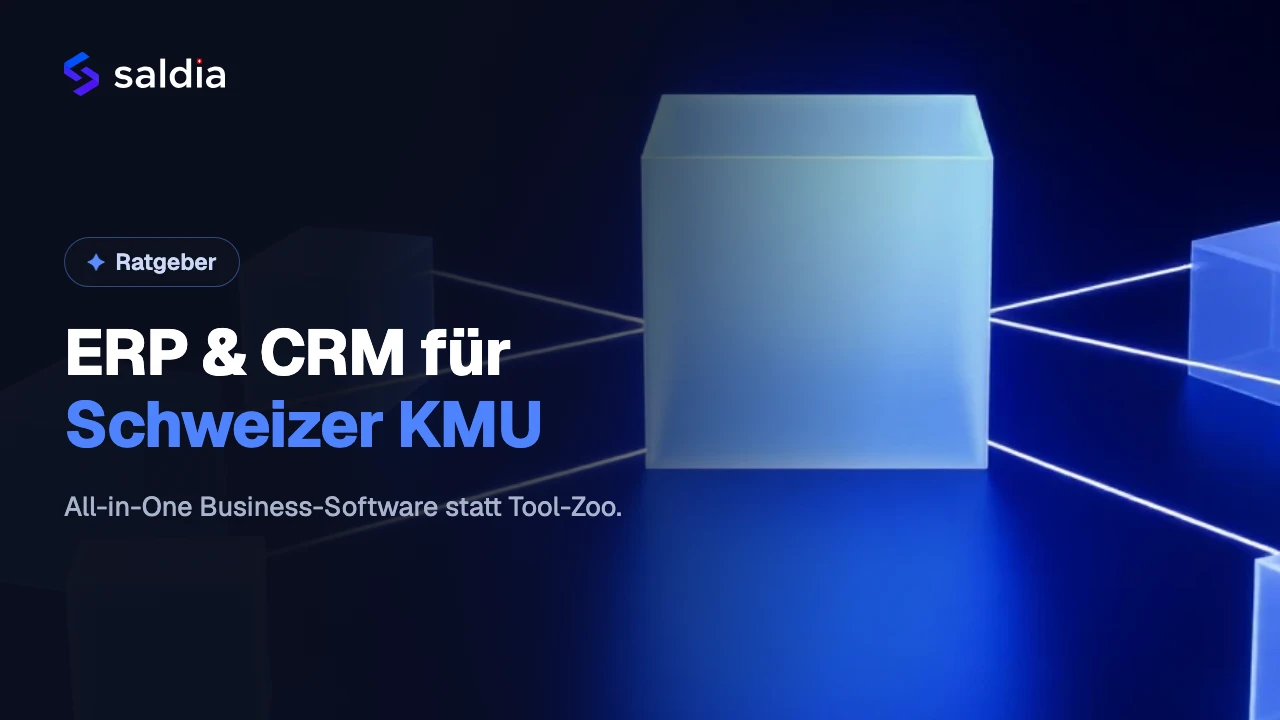
At some point it tips over. What started as a lean set of tools – a spreadsheet for the customer list, a separate ticketing program, a holiday calendar in someone's inbox, plus bexio for the books – becomes a burden. Data exists in several places, no one knows which version is correct, and every new hire has to juggle half a dozen logins. This guide sorts out when a Swiss SME really needs an integrated business platform with ERP and CRM, how to avoid tool sprawl – and, honestly, who is better off not making the move (yet).
What tool sprawl actually costs
Tool sprawl rarely comes from a single bad decision. It grows because each individual tool made sense on its own. The problem is not the single tool, it is the sum: information is scattered across many systems that do not talk to each other.
- Duplicate data entry: a new customer address ends up in the CRM, in accounting and in the shipping list – typed three times, three chances for error.
- Broken processes: a support request relates to an open order and an invoice, but the three systems do not know each other. No one sees the whole case.
- Knowledge disappears: what was agreed on a call lives in one person's notepad – not in a system the team can access.
- Onboarding gets expensive: every tool needs its own introduction, permissions and passwords.
The honest rule of thumb: as long as you keep the overview in your head, sprawl is a comfort problem. The moment orders slip through, customers get contacted twice, or you spend hours hunting for information, it becomes a business risk.
Five signals that you need an integrated platform
An ERP/CRM platform is not an end in itself. It pays off when several of the following apply to you – not on a single one alone.
- More than a handful of people maintain the same data. Once sales, support and accounting access customer information separately, you need a single source of truth.
- A case touches several areas. When a lead becomes an order, then a delivery, a support ticket and an invoice, that should hang together in one system.
- You lose inquiries or follow-ups. Leads nobody follows up on, or tickets without a clear owner, are a classic symptom of scattered tools.
- HR runs on notes and email. Holiday requests, time tracking and onboarding via email chains do not scale beyond a certain team size.
- You want reporting across areas. An analysis that shows revenue, pipeline and support load at a glance is barely possible with siloed solutions.
If only one of these signals applies, a focused single tool usually does the job. If three or more apply, you are working against your tools instead of with them.
saldiaCore: one platform for your entire business
saldiaCore is the all-in-one business software for Swiss SMEs. It brings together the areas that are otherwise spread across separate programs:
- CRM & sales: contacts and companies, a visual sales pipeline on a Kanban board, lead and deal scoring, automatic follow-up reminders and meaningful sales reports.
- Support & ticketing: requests from email, WhatsApp, phone (Aircall) and forms in one interface, with SLA tracking, macros and a knowledge base.
- Projects & tasks: projects with budget and phases, tasks with templates and relations, Kanban boards per project and global.
- Time tracking: log time directly on tickets and tasks – automatically assigned to the right customer and project, via a live timer or manually. Billable time turns into an invoice directly in bexio.
- HR & people: a time clock with Swiss break rules, absence and holiday requests, vacation calculation and timesheet verification with approval – kept separate from project-based time tracking.
- AI & automation: hybrid AI search across your data, AI reply suggestions in support and an automation engine that handles recurring routines – generated from a plain-text description if you like.
The decisive advantage is not the list of modules but that they connect: the customer history is visible across modules – from the first lead through the order to the support ticket. The standout is the continuous line from logged time to the invoice in bexio. saldiaCore is offered with pricing on request; the package is tailored individually to your team rather than calculated from a fixed list price. Prices may change. Hosting is in Switzerland, and support comes from Switzerland in German and French.
Important: a complement to bexio, not a replacement
Let us clear up a common misconception: saldiaCore is not a bexio alternative. It does not replace your accounting. On the contrary – saldiaCore works alongside bexio through your bexio connection. bexio remains your accounting and invoicing system; saldiaCore closes the gaps around it that a pure accounting tool does not cover: the CRM pipeline, support, projects, time tracking and HR.
In practice this means you create quotes through your bexio connection, and billable time from saldiaCore turns into an invoice directly in bexio – grouped by task, project or date. You run your day-to-day business in saldiaCore and keep clean books in bexio, without copying hours over by hand. So anyone who already uses and values bexio gives up nothing. Anyone who additionally wants to structure sales, support, projects and HR gets the layer on top with saldiaCore.
Rule of thumb: bexio does your books. saldiaCore does everything before and around the bookkeeping – and hands the documents over to bexio in order.
Recurring billing: how saldiaBilling fits in
One special case deserves its own attention: recurring revenue. Anyone billing subscriptions or maintenance contracts quickly hits the limits of manual invoicing. This is where saldiaBilling comes in. It manages subscription models (monthly, quarterly, yearly), creates recurring QR invoices, handles multi-stage dunning automatically and collects payments – also with bexio integration. Via saldiaPay, Swiss payment methods such as TWINT and credit cards are available. The result is a continuous line: saldiaCore runs the operational business, saldiaBilling automates the recurring billing, bexio books it – without you touching the same data three times.
Who it pays off for – and who it does not
Honest stays honest: an integrated platform is not the right move for everyone.
Worth it if: you have a growing team, several areas need the same data, cases run through multiple stages, you bill on a recurring basis, or you want reporting across departments. And if you already work with bexio and notice the operational layer around it is missing, saldiaCore is the natural complement.
Not (yet) necessary if: you work alone or as a pair and keep the overview comfortably in your head, if bexio plus one specialized tool fully covers your processes, or if none of your areas currently suffer from scattered data. Introducing a platform you only use a fraction of creates effort without return. Onboarding and migration cost time – that price only pays off when the problem solved is bigger than the switch.
The pragmatic middle path: start with the area that hurts most – often CRM or ticketing – and use the remaining modules as they are needed. Because everything sits in one platform, the value grows with you without adding a new system. For an overview of all modules, see our page on business software for Swiss SMEs.
Frequently Asked Questions (FAQ)
Does saldiaCore replace my bexio accounting?
No. saldiaCore is a complement to bexio, not a replacement. bexio remains your accounting and invoicing system, while saldiaCore covers CRM, support, projects, time tracking and HR. Through your bexio connection you create quotes and bill billable time directly in bexio – without copying hours over by hand.
When does an integrated ERP/CRM platform pay off for a Swiss SME?
It pays off when several signals come together: multiple people maintain the same data, a case touches several areas, inquiries or follow-ups get lost, HR runs on notes and email, or you want reporting across departments. If only a single signal applies, a focused single tool is usually enough.
Which areas does saldiaCore cover?
saldiaCore unites CRM & sales, support & ticketing, projects & tasks, time tracking, HR & people and AI & automation in one solution – plus gamification. The areas are connected, so the customer history is visible across modules and logged time turns into an invoice directly in bexio.
How much does saldiaCore cost?
saldiaCore is offered with pricing on request. Because the package is tailored individually to your team's requirements, you receive a custom quote rather than a fixed list price. Prices may change.
How does saldiaCore relate to saldiaBilling?
saldiaCore runs your operational business, while saldiaBilling automates recurring billing – with subscription models, recurring QR invoices and automatic dunning, also with bexio integration. Anyone who regularly bills subscriptions or contracts combines the two solutions sensibly.